


Freshers Advertising 2026: The Best Ways to Advertise to University Students
Freshers is one of the biggest opportunities in the UK student advertising calendar.
Every September, new and returning students arrive on campus, establish routines, discover local businesses and make decisions about the products and services they will use throughout university.

This creates an important window for brands. Students are not simply attending welcome events. They are opening bank accounts, subscribing to apps, buying clothes, furnishing rooms, reviewing mobile contracts and deciding where to eat, shop, socialise and exercise.
Successful Freshers advertising places your brand within this period of change.
The best campaigns reach students where university life is actually happening, communicate a clear benefit and remain visible after the Freshers’ Fair has finished.
Why is Freshers important for student advertising?
Freshers marks the beginning of a new stage of independence. Many students are managing their own money, accommodation and purchasing decisions for the first time.
It is often assumed that students organise everything before arriving at university. RockBox’s 2026 Freshers research suggests otherwise. Among the students surveyed:
43% opened or switched student bank accounts after arriving on campus
54% signed up for student subscriptions or apps after arriving
33% took out a new mobile phone contract after arriving
40% bought home or room essentials after arriving
Among students who purchased home or room essentials, 49% waited until they were already at university.
The opportunity also extends to fashion. In the same survey, 82% said they bought new clothing, footwear or fashion items for university. More than a third waited until they were on campus, while confirmed buyers who answered the spending question spent an estimated average of approximately £92.
The message for advertisers is clear: Freshers spending does not stop when students arrive. In many categories, that is when it begins.
What are the best ways to advertise to students at Freshers?
An effective student marketing campaign should combine reach, relevance, frequency and a strong reason to act.
1. Use on-campus digital advertising screens
The first rule of student advertising is to be present where students spend their time.
Digital out-of-home advertising screens inside universities and Students’ Unions allow brands to become part of the everyday campus environment. Students encounter campaigns while entering buildings, meeting friends, buying food, studying between lectures and attending events.

In RockBox’s July 2026 survey, 79% of students recalled noticing digital advertising screens on campus during the previous year. A further 38% said a deal or promotion shown on a campus screen had caught their interest.
This visibility is supported by repetition. Students return to the same social, study and catering spaces throughout the week, allowing university advertising campaigns to build familiarity rather than relying on a single impression.
RockBox currently operates more than 500 full-motion digital screens across over 100 UK universities and Students’ Unions, connecting advertisers with an on-campus audience of approximately 1.6 million students. Its campus environments offer an average dwell time of more than 30 minutes.
2. Do not rely solely on the Freshers’ Fair
Freshers’ fairs offer valuable face-to-face contact. They allow brands to distribute products, answer questions and create memorable experiences.
However, they should be treated as one part of a wider Freshers marketing strategy, not the entire campaign.
Almost one in three students surveyed by RockBox said they did not attend their Students’ Union Freshers’ Fair. A brand relying only on a stall could therefore miss nearly a third of its potential student audience.
A campus screen campaign can promote an activation before it takes place, direct students to it while it is live and continue the message after the event has ended.
This extends a one-day physical activation into a campaign lasting several weeks.
3. Reach students beyond halls of residence
Student accommodation can provide useful, repeated exposure among residents of selected buildings. It cannot, however, reach the whole university population.
Students may live:
In university-owned halls
In private student accommodation
In privately rented houses
At home with family
Outside the city and commute to campus
In the RockBox survey, 59% said they had never seen advertising screens inside their halls of residence at any point during their university studies. Only 41% recalled seeing them.
This makes central campus environments important. Students from different accommodation types still pass through Students’ Unions, libraries, cafés, lecture buildings and other shared university spaces.
Halls advertising can complement a campaign, but campus advertising provides the wider foundation for student reach.
4. Give students a genuine reason to pay attention
Students are highly aware of value. General brand advertising can build recognition, but a relevant offer gives them an immediate reason to engage.

Open-text feedback from the RockBox survey consistently asked for:
Food, grocery and coffee offers
Fashion and beauty discounts
Technology and laptop deals
Transport savings
Fitness and entertainment offers
Home essentials and stationery
Vouchers, freebies and giveaways
Local offers relevant to their university
Students also wanted simple conditions, meaningful savings and fewer promotions requiring a high minimum spend.
A successful Freshers advert should therefore answer three questions quickly:
What is being offered? Who is it for? How does the student claim it?
“20% student discount” is stronger than a vague promise of “great value”. “Free delivery for students” is clearer than a long paragraph describing the service.
The benefit should be visible within seconds.
5. Combine campus advertising with search and social media
On-campus advertising does not need to compete with digital marketing. It can make digital campaigns more effective.

A student may see a brand repeatedly on campus before searching for it later, visiting its website, downloading an app or recognising the same creative in a social media advert.
RockBox’s student survey reports that 63% of surveyed students had looked up a product after seeing it advertised on a campus screen.
For stronger integration:
Use the same colours, offer and message across your campus screens, paid social, landing pages and search advertising. Keep the campaign visually consistent so students recognise it wherever they encounter it.
Your call to action should also be easy to remember. A short promotional code, memorable product name or simple web address can sometimes be more effective than relying entirely on a QR code.
6. Make QR codes worth scanning
QR codes can work well in student advertising, particularly when they unlock something immediate.

Good reasons to scan include:
A student discount
A competition
A free product
An event registration
A voucher
A short survey with an incentive
RockBox advises that QR codes should be large, visible for long enough to scan and supported by a compelling value prompt. Its media pack recommends displaying QR-led creative for at least 15 seconds.
Avoid placing a small QR code in the corner without explaining what students receive. “Scan to learn more” is rarely as persuasive as “Scan for 25% off”.
7. Target campaigns by university, city or region
Not every student advertising campaign needs national coverage.
A national brand launch may benefit from broad campus reach, while a restaurant, employer, event or local retailer may only need selected universities.
RockBox campaign options include nationwide broadcast activity, individual campus targeting, regional university clusters, event support and longer-term campaigns with refreshed creative. Campaigns can also be planned around major student moments such as Freshers, Black Friday, Christmas, Refreshers and the Summer Term.
Location-specific creative can improve relevance. Examples include:
“Students of Birmingham”
“Five minutes from Leeds Students’ Union”
“Show your Manchester student card”
“Your first delivery in Bristol is free”
Localised university advertising feels more useful and less like a generic national campaign.
8. Advertise before, during and after Freshers
Freshers is not a single day.
International students may arrive earlier, accommodation move-in dates vary and Freshers’ fairs can take place across several weeks. Students then need time to settle in, understand their requirements and make purchasing decisions.
A strong campaign can be divided into three phases.
Before arrival: Introduce the brand, build awareness and communicate what students should prepare.
During Freshers: Lead with the strongest discount, event, giveaway or call to action.
After Freshers: Reinforce the message as routines and purchasing habits begin to settle.
RockBox used this phased approach for a CeraVe campus tour. Geo-targeted creative generated pre-event awareness, supported the activation while it was live and then changed to post-event brand messaging.
For many categories, the period immediately after Freshers may be as commercially important as Freshers Week itself.
How should you design a Freshers advertising campaign?
Campus creative needs to work quickly.
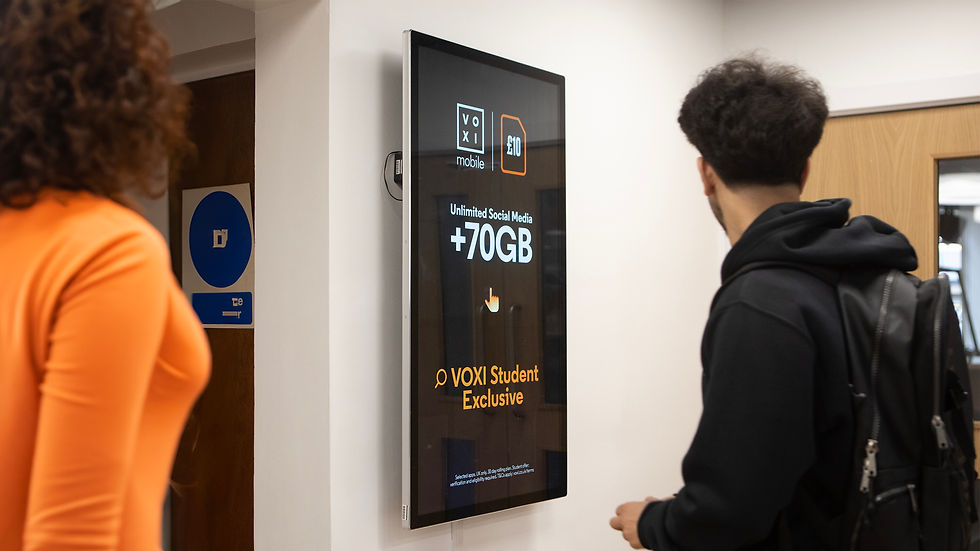
Students may encounter an advert while walking through an entrance or corridor, but they may also see it repeatedly while eating, studying or socialising.
The best student advertising creative normally has:
One clear message
Do not try to explain your entire company in one advert. Choose the single most important benefit.
A prominent student offer
Make the discount, free trial, event or giveaway one of the largest elements on screen.
Strong branding
Students should be able to identify the advertiser even when they only see part of the advert.
Minimal text
Use a headline, supporting line and call to action. Long paragraphs are difficult to absorb on an advertising screen.
Motion with purpose
Animation can attract attention, but the important message must remain visible long enough to read.
Social-compatible creative
Portrait campus screens can often use the same 9:16 format as TikTok, Instagram Reels and Stories. RockBox portrait screens accept MP4 and JPG creative, with adverts shown for 10 seconds in every 60 seconds.
A simple next step
Tell students exactly what to do: scan, download, search, visit, register or show their student identification.
Does student advertising deliver measurable results?
Modern campus advertising can be measured through more than estimated impressions.
Campaign reporting can include:
Screen plays
Estimated footfall and impressions
QR scans
Promotional code use
Website traffic
Branded search activity
App downloads
Student surveys
Ad recall
Brand consideration
Purchase intent
RockBox recorded more than 1,200 direct-to-screen student survey completions during the 2025/26 academic year. Surveys can be conducted before, during or after activity to assess campaign response.
The RockBox Cadbury campaign achieved 71% ad recall among surveyed students, alongside increased brand consideration and positive association. A Freshers campaign for Pop-Tarts achieved 50% ad recall, with 48% of surveyed students saying they were more likely to buy after seeing the advert.
Results will vary by campaign, creative, offer and audience, but these examples demonstrate why student advertising should be planned with clear objectives and measurement from the start.
What types of brands should advertise during Freshers?
Freshers advertising can work for almost any organisation with a relevant student product, service or opportunity.
Common categories include:
Banks and financial services
Food and drink brands
Restaurants and delivery apps
Fashion, beauty and retail
Mobile networks
Technology and laptops
Streaming and entertainment
Travel and transport
Gyms, sport and wellbeing
Home and room essentials
Graduate employers
Universities and education providers
Charities and public-sector campaigns
Local events and attractions
The key is not whether the brand traditionally considers itself a “student brand”. It is whether it can offer something relevant to students at a moment when they are forming new habits.
The best Freshers advertising reaches students in real campus life
The most effective way to advertise to students is not to depend on one fair, one social platform or one accommodation network.

A stronger student marketing strategy combines physical presence with digital response:
Use on-campus screens for reach and repeated visibility
Use Freshers’ fairs and activations for direct interaction
Use social and search to reinforce the message
Offer students real and immediate value
Continue activity after the opening week
Measure what students notice and do next
Freshers creates the opportunity, but relevance converts it into results.
RockBox places brands inside busy university and Students’ Union environments across the UK, helping advertisers reach students while they eat, study, meet friends, attend events and establish their new routines.
To plan a national, regional or university-specific Freshers advertising campaign, contact sales@rockboxadvertising.com or request the latest RockBox Student Advertising Media Pack.


